
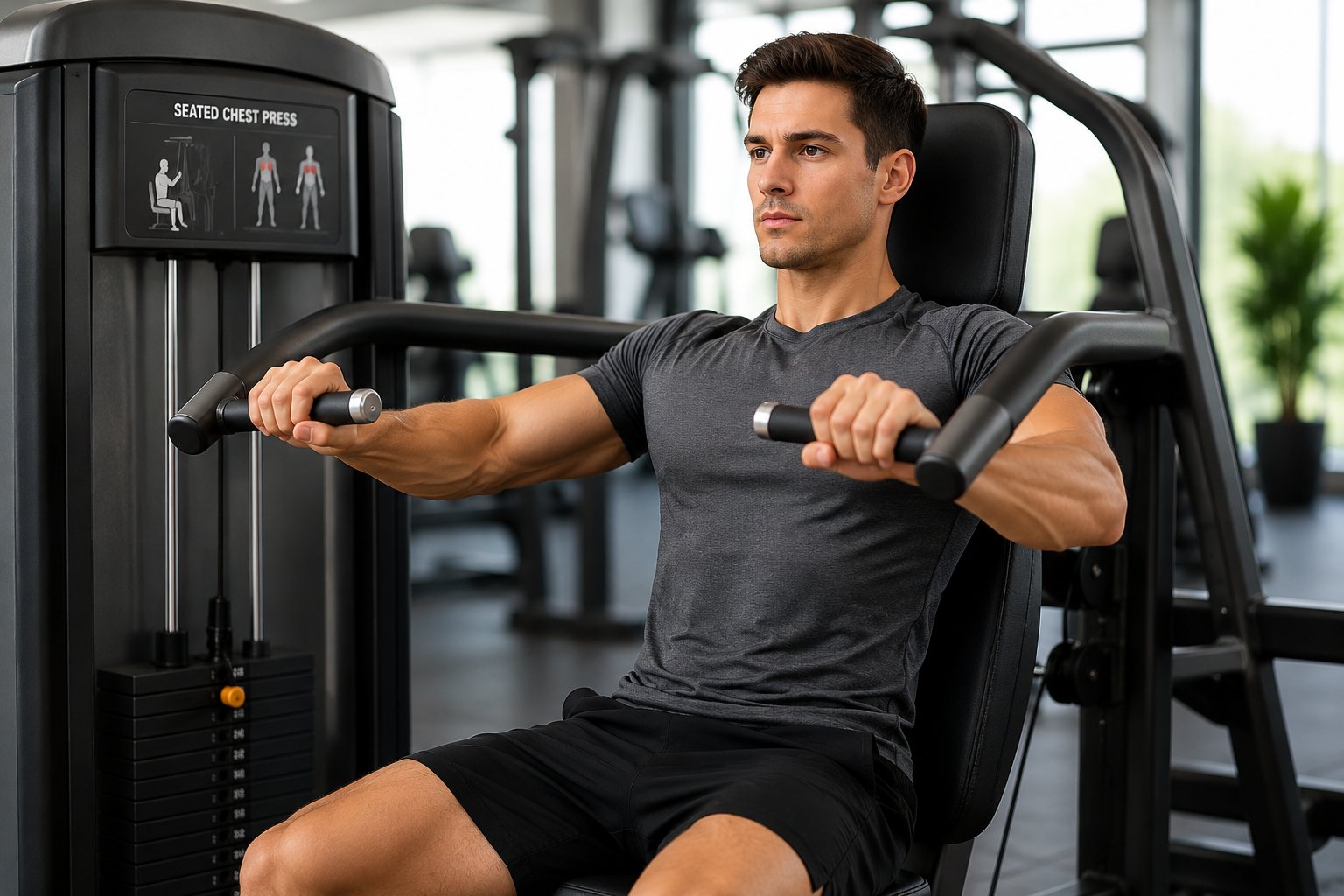
How the fitness industry quietly severed the connection between your mind and your muscles — and what MisterG’s IPCM system in gTonnicks is doing to restore it.
By MisterG · Fitness & Wellness Architect · gTonnicks System
Neuromuscular science IPCM gTonnicks EMG research
Walk into any commercial gym in America and you will find rows of gleaming machines — cable stacks, leg presses, Smith machines, chest fly contraptions bolted to the floor in perfect alignment. They look impressive. They feel safe. They are, by design, foolproof. And that, precisely, is the problem.
The fitness industry has spent decades perfecting equipment that does your thinking for you. Guided tracks eliminate the need for stabilization. Fixed ranges of motion remove balance entirely. Padded supports offload the postural work your body should be doing itself. The machine moves. You just show up. And slowly, quietly, the neural conversation between your mind and your body goes silent.
“The fitness industry have been fooling you by making you use more machines for exercise, thus creating a disconnect between your mind and your body.”
This is not an accident. It is a business model. Machines are marketable. They photograph well. They justify gym memberships and equipment sales. But the human body was not designed to move on rails. It was designed to think, feel, stabilize, coordinate — and contract with intention.
What science says about the disconnection
Electromyography — EMG — is the science of measuring the electrical signals muscles produce when they contract. Attach surface sensors to a muscle and you can observe, in real time, whether it is firing, how intensely, and in what sequence relative to other muscles. It is, effectively, a window into the neurological conversation your nervous system is having with your body during movement.
What EMG research reveals about attention and muscle activation is both striking and vindicating for those who have long argued that how you think during exercise changes what your body actually does.
EMG Research Finding #1 — Attentional Focus
Studies show that when subjects directed their attention internally — consciously focusing on contracting a specific muscle — EMG amplitude in the targeted muscle increased significantly during both dynamic and isometric tasks, compared to an external or unfocused condition. This effect was most prominently demonstrated in the abdominal musculature.Karst & Willett; Schoenfeld BJ, Journal of Strength and Conditioning Research, 2010 · ResearchGate, 2025
EMG Research Finding #2 — Muscle Growth
In an 8-week resistance training study, subjects instructed to “squeeze the muscle” on every rep — employing deliberate internal focus — demonstrated superior biceps hypertrophy compared to those told simply to “get the weight up.” The mind-muscle connection did not merely change activation levels. It changed physical outcomes.Schoenfeld BJ, lookgreatnaked.com · Journal of Strength and Conditioning Research
EMG Research Finding #3 — Bench Press & Plank
During controlled bench press and plank exercises, internal focus on the pectoralis major or abdominal muscles produced measurably higher normalized EMG activity in those muscles compared to groups using regular or external focus conditions — confirming that intentional contraction is a trainable and measurable skill.Multiple studies compiled by ResearchGate, November 2025
The implications are significant. If conscious focus on a muscle increases its activation and drives greater hypertrophy, then every workout completed on autopilot — moving weight from A to B without internal awareness — is a workout that left measurable results on the table. Machines, by removing the need for that internal focus, may be actively working against you.
Enter IPCM: the antidote
Intentional and Purposeful Contraction of the Muscles — IPCM — is the foundational principle of the gTonnicks movement system developed by MisterG. It is not a technique layered onto exercise. It is the prerequisite for it.
IPCM demands that the practitioner feel, identify, and intentionally recruit the target muscles and their synergists before and throughout every movement — not merely complete the rep. It begins not with the arms, not with the legs, but with the abdomen.
IPCM sequence by movement type
Movement
Push-up
Primary anchor
Abdomen (core canister)
Secondary chain
Quads → Shoulders → Pecs → Arms
Movement
Squat
Primary anchor
Abdomen (core canister)
Secondary chain
Thighs — sustained throughout
Movement
Leg extension
Primary anchor
Abdomen (core canister)
Secondary chain
Stabilizers + Quads → full chain
Movement
All movements
Primary anchor
Abdomen — always first
Secondary chain
Movement-specific, simultaneous at advanced level
The anatomical rationale is sound. The core — comprising the diaphragm, transverse abdominis, obliques, and pelvic floor — functions as a pressurized canister. When intentionally activated first, it stabilizes the spine before load is applied, creates a neurological foundation for the entire kinetic chain, and prevents the energy leaks that characterize unfocused, machine-dependent movement.
Teaching the body to feel again
What distinguishes gTonnicks from other approaches is not just the principle of IPCM, but the pedagogy — the method by which a complete beginner, someone who has never consciously felt a muscle engage, is taught to rebuild that internal language from the ground up.
The process begins standing upright. MisterG places his fingers directly on the target muscle, giving the nervous system a tactile reference point it can locate and return to. He then asks a question the body already knows the answer to: “Remember how your abdomen contracts when you cough or laugh?” That involuntary, familiar sensation becomes the bridge to voluntary, intentional control. The unconscious becomes conscious. The automatic becomes purposeful.
“You are not learning something new. You are reclaiming something your body already knows how to do — and making it yours on purpose.”
From there, the student contracts all major muscle groups simultaneously — abdomen, thighs, glutes, calves — holding that full-body tension in a standing position. This is not strength training. It is neuromuscular orientation: teaching the body what total intentional engagement feels like as a unified system, so it can be recalled on demand during movement.
Simple movements follow: leg front extensions, side leg extensions — selected not for their difficulty, but for their capacity to demand core anchoring while being simple enough not to overwhelm the newly awakened system. The wiring is built before the load is applied.
The gBalance Bar: no place to hide
As IPCM takes root, the gTonnicks system introduces its most distinctive tool: the gBalance Bar (gBB) — a freestanding, unanchored pole 42 to 48 inches in length, weighing just under one pound. It is not a support. It is a witness.
Beginners and intermediate practitioners place only their fingertips on the top tip of the gBB. That minimal contact — too light to bear weight, too honest to accept compensation — provides sensory feedback without structural support. The body cannot lean on it. It can only detect through it. Any breakdown in stabilizer engagement, any lapse in core activation, and the bar shifts. The body is caught. Immediately. Honestly.
At the advanced level, the gBB is held entirely off the ground in what gTonnicks calls the “knife grip” — the bar held firmly between the root of the thumb and palm, fingers fully extended together, replicating the hand position of a martial arts striking technique. The bar is now entirely airborne. The floor has been removed as a reference. Balance, stability, IPCM, and deliberate upper body tension must all be maintained simultaneously across every movement in the gTonnicks standing repertoire.
The sub-one-pound weight is precisely calibrated: light enough that it cannot serve as an external counterweight or muscle-loading tool, yet heavy enough that sustained holding in knife grip quietly, gradually conditions the shoulders, deltoids, trapezius, and upper back — not as a deliberate training stimulus, but as an elegant byproduct of correct execution.
What the machine cannot give you
No machine teaches this. No guided cable, no seat-adjusted press, no padded leg extension apparatus with a pin-loaded weight stack develops the internal neuromuscular language that IPCM builds. Machines produce outputs — reps, sets, weights lifted. IPCM produces ownership: a body that knows itself, that can feel what is firing and what is not, that can recruit the right muscles in the right sequence under load, under fatigue, and in the unpredictable conditions of real physical life.
The EMG research confirms what MisterG has always known through practice: the quality of your attention during movement determines the quality of your body’s response to it. You can complete a thousand reps on a machine and remain a stranger to your own musculature. Or you can perform a single intentional, purposeful contraction — and begin, for the first time, to actually train.
“The machine moves. gTonnicks thinks. That is the difference between exercise and intelligence.”
Scientific references
- Karst GM & Willett GM — “Onset timing of electromyographic activity in the vastus medialis oblique and vastus lateralis muscles.” Physical Therapy, 1995.
- Schoenfeld BJ — “The mechanisms of muscle hypertrophy and their application to resistance training.” Journal of Strength and Conditioning Research, 24(10), 2010.
- Schoenfeld BJ — “The mind-muscle connection: A key to maximizing growth?” lookgreatnaked.com / JSCR peer-reviewed follow-up.
- ResearchGate scientific consensus — “What is the connection between focus of attention and electromyography (EMG)?” November 2025.
- Vance J et al. — “EMG activity as a function of the performer’s focus of attention.” Journal of Motor Behavior, 36(4), 2004.
- Snyder BJ & Leech JR — “Voluntary increase in latissimus dorsi muscle activity during the lat pull-down following expert instruction.” JSCR, 23, 2009.