
Why How You Move May Matter as Much as How Long You Live
For decades, scientists and health professionals have searched for reliable ways to predict longevity and healthy aging.
They have measured blood pressure, cholesterol, body fat, cardiovascular fitness, grip strength, walking speed, balance, and countless biomarkers. These assessments have proven valuable because they often reveal risks long before symptoms appear.
Yet an important question remains:
Do these tests tell us how well a person can actually function in everyday life?
After more than three decades of working with individuals ranging from everyday adults to elite performers, executives, athletes, and celebrities, I have observed a consistent pattern:
Many people possess acceptable health numbers but struggle with movement quality, stability, posture, balance, coordination, or body control.
Conversely, some individuals who may not appear extraordinary on paper move with remarkable efficiency, confidence, and vitality well into their later years.
This observation led to the development of a concept I call:
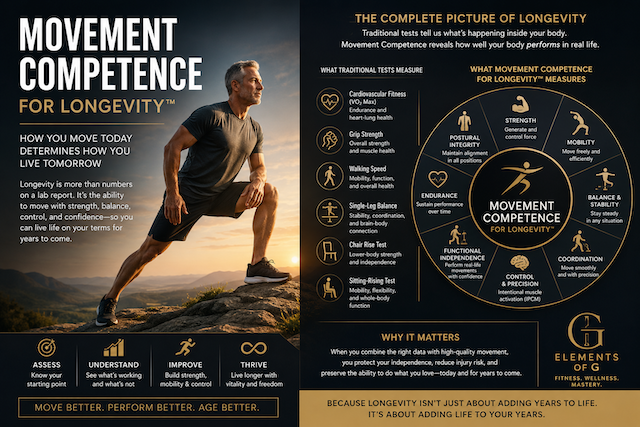
Movement Competence for Longevity™
Movement Competence for Longevity™ is the ability to move through life with strength, balance, control, precision, efficiency, and confidence.
It is not simply about whether you can perform a movement.
It is about how well you perform it.
Because ultimately, longevity is not merely about adding years to life; it is about preserving the quality of those years.
What Traditional Longevity Tests Measure
Researchers have identified several physical assessments that correlate strongly with health and lifespan.
Grip Strength
Often referred to as a biomarker of aging, grip strength provides insight into overall muscular health, nervous system function, and future independence.
Walking Speed
Known as the “sixth vital sign,” walking speed reflects cardiovascular fitness, strength, balance, and neurological health.
Single-Leg Balance
Balance is increasingly recognized as an important predictor of future health outcomes because it reflects coordination, reaction time, stability, and brain-body communication.
Chair Rise Test
The ability to repeatedly stand from a seated position demonstrates lower-body strength and functional independence.
Sitting-Rising Test
This popular assessment measures the ability to move from standing to the floor and back up again with minimal assistance.
Cardiorespiratory Fitness (VO₂ Max)
Perhaps the strongest predictor of longevity, aerobic fitness reflects the body’s ability to deliver and utilize oxygen efficiently.
Each of these tests contributes valuable information.
However, they share one limitation.
Most focus on whether a task can be completed; not how competently it is performed.
The Missing Piece: Movement Quality
Imagine two individuals capable of standing on one leg for thirty seconds.
The first person:
- Wobbles constantly
- Holds their breath
- Tightens their shoulders
- Compensates through poor posture
The second person:
- Maintains alignment
- Breathes naturally
- Remains stable and relaxed
- Demonstrates effortless control
Traditional scoring systems often consider these individuals equal.
Movement Competence for Longevity™ does not.
The difference between merely completing a movement and mastering a movement may represent an important distinction in how the body ages over time.
Why Movement Competence Matters
Every movement requires communication between:
- Brain
- Nervous system
- Muscles
- Joints
- Connective tissue
- Balance systems
As we age, this communication often deteriorates.
The result is:
- Reduced mobility
- Poor posture
- Falls
- Chronic pain
- Loss of independence
- Decreased confidence
Movement competence seeks to preserve this communication.
The better the communication, the better the movement.
The better the movement, the greater the likelihood of maintaining independence and vitality.
Beyond Fitness: Functional Youthfulness
At Elements Of G, we are interested in more than fitness.
We are interested in what I call Functional Youthfulness.
Functional Youthfulness is the ability to:
- Move freely
- Maintain balance
- Rise from the floor effortlessly
- Navigate daily activities confidently
- Demonstrate strength without strain
- Maintain posture under stress
- Control the body intentionally
Many people lose these abilities long before they become medically ill.
Movement Competence for Longevity™ seeks to identify and improve them before they become limitations.
The Role of IPCM
A foundational principle of the gTonnicks Method is IPCM, Intentional and Purposeful Contraction of the Muscles.
IPCM trains individuals to reconnect the mind and body by consciously activating muscles with precision and purpose.
This intentional engagement enhances:
- Neuromuscular awareness
- Balance
- Stability
- Strength
- Postural control
Rather than simply performing movement, participants learn to understand movement.
This distinction is central to Movement Competence for Longevity™.
How Movement Competence Complements Traditional Assessments
Movement Competence for Longevity™ is not intended to replace established longevity indicators.
Instead, it complements them.
Traditional assessments tell us:
What is happening inside the body.
Movement Competence tells us:
How effectively the body expresses those capabilities through movement.
Together they provide a more complete picture.
For example:
Body Scan Assessment™
Answers:
“What is your body made of?”
Longevity Biomarkers
Answer:
“How healthy are your systems?”
Movement Competence for Longevity™
Answers:
“How well can your body perform the activities that make life enjoyable and independent?”
This combination creates a powerful framework for evaluating both lifespan and healthspan.
The Ultimate Goal
The goal is not simply to live longer.
The goal is to maintain the ability to:
- Travel
- Play
- Work
- Explore
- Compete
- Create
- Enjoy relationships
- Experience life fully
Longevity without capability is merely survival.
Longevity with competence is freedom.
That is the purpose of Movement Competence for Longevity™.
Because true longevity is not measured only by the number of years you live.
It is measured by how fully you are able to live them.